Almost a year after the note “Why the Rich Should Welcome Higher Rates”, with rates massively higher and all financial assets priced lower as a result, seems like a good time to revisit. Is inequality improved? Are asset owners worse off? I think the answer to both questions is no.
Consider the SPX total return index over the prior 15 years, comparing the spot price to the forward price for 2036, calculated using the prevailing 2036 Treasury bond yield as the discount rate.
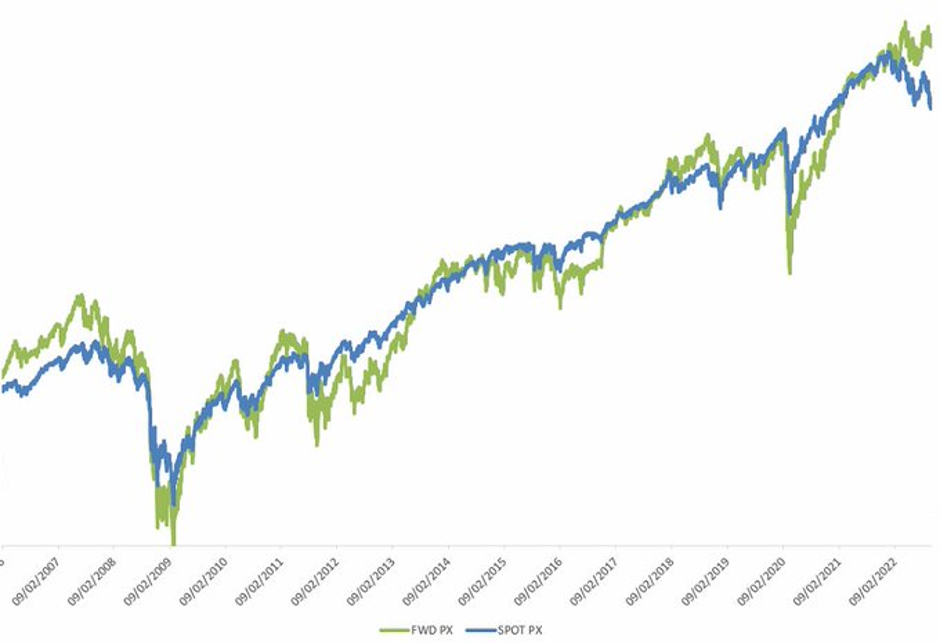
There are a few interesting observations. Unlike 2008 and 2020, where the forward price dropped more than spot, the 2022 drawdown is merely the result of lower valuations in line with higher rates. The forward price is largely unchanged.
Are asset owners worse off? Their assets are priced lower but income is unaffected. Provided they are still net buyers of financial assets, either directly via savings or indirectly via reinvesting corporate profits at higher returns, their wealth is set to increase further.
Zooming into the prior five years sharpens the contrast with the 2020 crash, when the forward price crashed more than spot, and the similarity with the earlier tightening cycle of early 2018 when the forward went higherm and then 2019, when spot caught up after the Fed pivot.
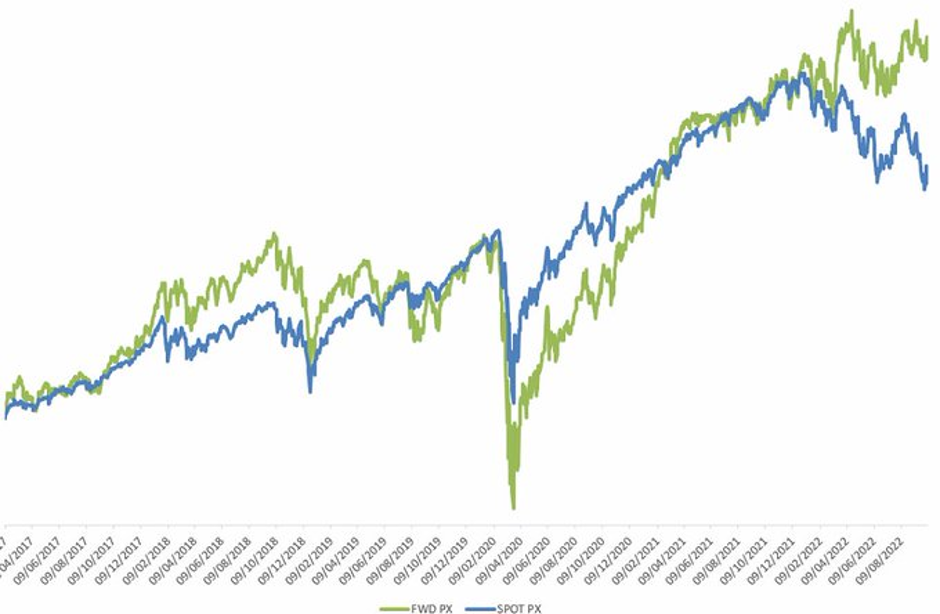
This doesn't have any price predictive power, to be clear. You can use it to draw any conclusion that fits your bias. It can be read as bullish (asset prices are very healthy, future income is higher) or bearish (prices haven't actually started coming down yet, more pain to come). But it is useful for perspective: assets are priced off future returns, and the discounting mechanism (interest rates) is a crucial element of the process. Looking at spot prices in a vacuum can be deeply misleading.